On June 9, 2020, Olivier Bassil, Benjamin Lasnier, and Lukas Benjamin Leth filed a lawsuit for copyright infringement in the U.S. District Court for the Central District of California against Jaques Webster, professionally known as Travis Scott, and his co-writers of their smash hit song “Highest in the Room.” Bassil, a French citizen and LA-based producer, co-wrote the guitar parts of the musical work “Cartier” while on Skype with Lasnier and Leth, both Danish citizens. The trio are reputed musicians and producers who have worked “with many emerging and established hip hop artists.” According to the complaint, Travis Scott’s hit song “Highest in the Room” infringes the copyright to “Cartier.”
For Plaintiffs to prove copyright infringement in the Ninth Circuit, they must show that (1) they owned a valid copyright to the musical work “Cartier” (there is prima facie evidence of validity based on the copyright registration of the composition and sound recording of “Cartier” with the United States Copyright Office on December 17, 2019) and (2) Scott and the other defendants unlawfully copied elements of “Cartier” such that it constitutes misappropriation. In Skidmore v. Led Zeppelin, the en banc Ninth Circuit explained the several components to misappropriation often collectively referred to as “substantial similarity.”
(1) Copying by defendants: The plaintiff must first prove that the defendant copied from the plaintiff’s copyrighted work by either (i) directive evidence of the defendant’s copying or (ii) the plaintiff “can attempt to prove it circumstantially by showing that the defendant had access to the plaintiff’s work and that the two works share similarities probative of copying.” In this case, Plaintiffs appear to be pursuing the latter theory: defendants had access to “Cartier” and similarities between the two songs exist.
(2) Misappropriation by defendants: If copying is proven, the final question is misappropriation. The Ninth Circuit divides this determination into two: (1) The extrinsic test, compares the objective similarities of specific expressive elements in the two works. Crucially, because only substantial similarity in protectable expression may constitute actionable copying that results in infringement liability, “it is essential to distinguish between the protected and unprotected material in a plaintiff’s work.” (2) The intrinsic test, “test[s] for similarity of expression from the standpoint of the ordinary reasonable observer, with no expert assistance.”
The Plaintiffs’ Allegations of Copying by Defendants:
Lasnier to Lepr: The main theory of Plaintiffs’ argument of copying is that the defendants had access to the Plaintiffs’ “Cartier” through Lasnier emailing a copy of it to several people associated with Scott. Lasnier emailed the work to Defendant Lepr, allegedly a producer and engineer of Scott’s song. The complaint does not specify the exact date of this email, but includes several emails sent by Lasnier to Lepr with beats or samples: (1) “12 new melodies” on March 13, 2019; (2) two works “Distort” and “Mercy” on March 19, 2019; (3) “12 original samples/melodies” on April 8, 2019; (4) “12 original samples/melodies” on April 14, 2019; and (5) “12 melodies” on April 22, 2019. If our math is correct, Lasnier sent Lepr 50 tracks in a little over a month. But it’s not clear if the “12 new melodies” refers to 12 separate songs, or 12 tracks, loops, or beats for 1 song. In any event, the complaint paints a picture of Lasnier emailing a lot of material to Lepr in the hope of a collaboration. Although we have not found Lepr or Cash Passion listed as a producer of “Highest in the Room” after our quick online search, a 2016 HipHopDX interview of Lepr indicates he has engineered Travis’s “If You’re Reading This It’s Too Late.”
The complaint alleges that it is customary in the music industry for producers, like Plaintiffs, to email their music to other producers and hip-hop artists in hopes of a collaboration or potential license. Between Jan. 19, 2019 and May 22, 2019, the plaintiffs emailed their song and other works “to at least one hundred (100) different music producers and/or hip-hop artists, including but not limited to, Tyga, MurdaGanggeno, Cdot Honcho, Don Q, Ace Hood, Boe Sosa, Daboii, Sage the Gemini, Yalla Beezy, Derez Deshon, Comindine, Ykosiris, Sauve, Global Dan, Paperlovee, and Jesus Honcho.” Wow.
According to the Plaintiffs’ complaint, “[o]n or about December 2018 Plaintiff Lasnier and defendant Lepr (aka Cash Passion) connected with one another via Instagram’s Direct Messaging feature. Plaintiff Lasnier and Defendant Lepr began following one another’s accounts at this time. Plaintiff Lasnier has a very large social media following, including the verified Instagram account @benjaminlasnier, which has more than 766,000 followers, including @cash_passion (Defendant Lepr).” Then, “[o]n or about December 14, 2018, Plaintiff Lasnier sent Defendant Lepr a direct message on Instagram asking whether Defendant Lepr would be interested in listening to Plaintiffs’ music and collaborating. Defendant Lepr replied on or about December 18, 2018, stating “Of course bro send on thru” and provided his personal email address.”
In the beginning of 2019, Lasnier allegedly posted a video of the full sound recording of “Cartier” to his Instagram story on three occasions to garner potential interest from other producers or hip-hop artists. After posting these videos of “Cartier” to his Instagram story, Lasnier and Lepr direct messaged each other via Instagram in March and April 2019. During these exchanges, Lasnier sent Lepr “Cartier” and other music. Lepr allegedly replied with great enthusiasm to Lasnier’s DMs: “Thank you bro. I haven’t been getting back to u but just know I’m making some moves with your shit.”
Lasnier to Frascona and OZ: The complaint alleges that Lasnier emailed the same tracks (referred to as “12 original samples/melodies”) separately to Defendants Nik Frascona in September 2019 and Ozan Yildirium (aka OZ) on May 22, 2019. Frascona and OZ are both co-writers of Scott’s “Highest in the Room.”
Widespread dissemination?: The complaint also suggests that a recording “Cartier” was in widespread dissemination (although the complaint doesn’t explicitly use this term) based on Lasnier’s sharing of a video of it on his Instagram account: “The three videos featuring the Original Work are saved to Plaintiff Lasnier’s account and publicly visible to anyone who clicks on or follows his Instagram account. On information and belief, the three videos featuring the Original Work have been viewed well over a hundred thousand times.”
Based on the emails and direct Instagram messages exchanged between Lasnier and Lepr, and some with Frascona and OZ, the Plaintiffs allege Defendants had access to the song “Cartier.”
The Plaintiffs’ Allegations of Substantial Similarity and Misappropriation by Defendants:
The complaint alleges there is substantial similarity between “Cartier” and “Highest in the Room” through “at least three compositional similarities.” The alleged similarities are:
(1) the arpeggio melody scales: “Cartier” has the pattern 3-1-5-3-1-5-3-5, 2-5-2-5-2-5. “Highest in the Room” has the pattern 3-1-5-3-1-5-3-2-3, 2-7-5-2-7-5-1-1-2. [bold indicates differences]
(2) chord sequences: minor tonic (i) to minor dominant (v), and
(3) a descending melodic line (Scale degrees 3-2) built into the arpeggio melody and appearing in multiple forms throughout both “Cartier” and “Highest in the Room.”
The Complaint includes the following comparison when the songs are transposed in the same key of A minor and same rhythmic scale:
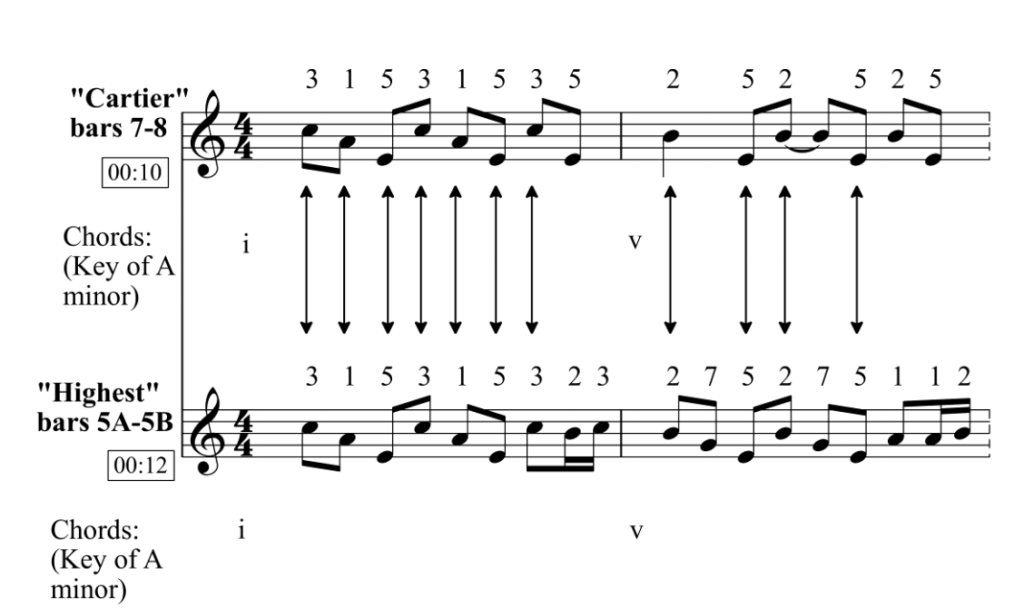
According to the complaint, “The arpeggio melody recurs without variation not less than 24 times in the Infringing Work/Infringing Sound Recording totaling at least one minute and fifteen seconds (1:15) out of the 2 minute and 55 second (2:55) full duration of the Infringing Work/Infringing Sound Recording – in sum, nearly half of the Infringing Work/Infringing Sound Recording is comprised of the Original Work’s melody.” The complaint alleges that these features are essential to the originality of “Cartier,” and are readily apparent to the ordinary listener of “Highest in the Room,” according to the complaint. The Plaintiffs claim that Scott and the other defendants willfully infringed upon Plaintiffs song “Cartier.”
What’s at Stake: The Plaintiffs are seeking all profits and revenues from “Highest in the Room,” derived from the infringing portion of “Cartier.” That amount is potentially large. The complaint alleges that “Highest in the Room” has generated at least $20,000,000 in revenue. The song is one of Scott’s biggest hits and continues to be performed, purchased, streamed, and licensed. A music video for “Highest in the Room” has well above 250,000,000 views on YouTube. After its release, “Highest in the Room” immediately went to No. 1 on the Billboard Hot 100 chart. The song sold more than 2,000,000 copies meaning it is certified as 2x Platinum. Scott toured throughout 2019 and performed this song consistently at his shows. “Highest in the Room” was licensed to Beats Audio, Fortnite, Bleacher Report, the NBA, and to Kylie Cosmetics.
This case may open the door to other similar cases where potential collaborations go awry, particularly in the hip-hop/rap industry. Collaboration is prevalent in the hip-hop/rap community, and the online sharing of beats, hooks, and other musical elements, digitally created on computers, is growing rapidly via social media and online platforms where people buy and share digital beats. The Internet can help facilitate collaboration in creating music, but it comes with risks. Social media users can easily share other people’s works or take the works for themselves without negotiating agreements or licenses ahead of time. This case could force musicians and producers who share their creations online into being more careful with their own beats and music. Not sure it’s prudent to send 50 samples to a third party without an agreement in place.
We haven’t located a copy of the plaintiffs’ song so we are unable to compare the two songs at the moment. If we find it, we will update this article. But if you’re interested in a digital breakdown of Scott’s “Highest in the Room,” here’s an excellent analysis, including the guitar section, by Paul Allen on YouTube:
–by Annika Morin and Edward Lee
Songs
“Cartier” by Olivier Bassil, Benjamin Lasnier, Lukas Leth
“Highest in the Room” by Travis Scott
Documents
Complaint by Bassil, Lasnier, Leth
Attorneys
Richard S. Busch, Keith Kelly, King & Ballow
 Music Infringement